

Written By: Dr. Conrad Gottfredson, Founding Partner and Chief Learning Strategist, APPLY Synergies
There is a quiet thing starting to happen inside organizations right now, and it is not the technology.
It is the end-around.
Work teams are reaching past L&D and using AI directly to meet what they perceive to be their own learning needs. Executives are doing the same thing one floor up, reasoning that if AI can answer the question, explain the process, and generate the job aid, then perhaps the function that used to do those things is an expense rather than an asset.
L&D faces two risks and an opportunity in this moment. The risks are old but dressed in new clothes, and the opportunity gives L&D a legitimate claim to strategic leadership — if we act now.
Risk 1: Failure to deliver measurable business impact
Failure to deliver measurable business impact is a long-standing risk that has loomed over L&D from its inception. The completion data we have traditionally handed back to the business certainly won’t protect L&D in this age of AI. Without hard data showing direct business impact, executives will eliminate much if not all of L&D, believing they can employ AI directly to better meet the organization’s learning needs and impact work performance. The fix is to intentionally orchestrate learning while working in the flow of work. This requires AI-enabled Digital Coach capabilities that enable employees to close their own skill gaps, real-time, in the flow of work. Time to effective performance, time to changed performance, and time to full productivity become measurable with a Digital Coach supporting job performance at the point of work (the only place performance can actually be measured).
(For more detail see: Remaining relevant in the transformational juggernaut of AI )
Risk 2: Failure to deliver solutions fast enough
If we fail to deliver solutions fast enough, work teams will make an AI end-around. They will conclude they can employ AI directly to meet their own learning needs faster than working with L&D.
Traditional design and development cycles worked in a world where content stayed still long enough to be built into stable learning solutions. That world is gone. When a team can get a serviceable answer from a chatbot in eleven seconds, a twelve-week development cycle is not a feasible process: it is an invitation to go around us.
The fix here is not mysterious. It is to use AI to compress workflow learning design methodology end to end. We need to rapidly engage key stakeholders, optimize scarce SME time, accelerate time to solution implementation, and accelerate time to changed performance. Every phase of a disciplined workflow learning methodology has steps where AI can eliminate days or weeks without diminishing rigor. This is inside work. We control it.
Opportunity: Demonstrate strategic leadership
Every organization is now deciding, thousands of times over, how much work should be automated by AI. Most are making that decision at the wrong altitude. They are asking it at the level of the job/role (“can AI do the underwriter’s job?”) or at the level of the tool (“should we deploy this platform?”). Both framings produce the same two failures: either the organization automates something it shouldn’t and discovers the cost after the damage is permanent, or it freezes, automates nothing, and pays a different kind of price.
Notice who is not in that conversation. IT owns the platforms. Security owns the threat surface. Operations owns the process. Legal owns the exposure. But nobody owns the question of which specific unit of work should be performed by a human, by AI, or by some negotiated arrangement between them.
That question is best answered by L&D. Here is why.
The fundamental unit of work performance is the job task. Not the job. Not the process. Not the tool. The task. It is the smallest unit at which you can say something meaningful about what it takes to perform, what happens when performance fails, and who or what is capable of doing it.
L&D inherently works at the task level. We can employ AI to help us rapidly map workflows down to the job tasks. AI can also help us assess those tasks against two key variables: how difficult or complex the task is to perform, and how bad things get when it’s not performed or performed incorrectly.
Organizations desperately need our help assessing tasks at the level of difficulty/complexity and the critical impact of failure if performed ineffectively.
If we fail to protect the organization and its workforce by stepping up and providing this help, L&D will miss a vital opportunity to demonstrate strategic leadership and save the business and its workforce from suffering devastating harm.
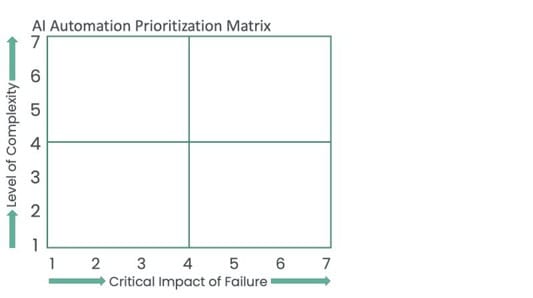
The AI Automation Prioritization Matrix
Take any job task and rate it on two scales.
Critical Impact of Failure (CIF) — 1 to 7
This asks: if this task is performed badly, what happens?
| Rating | Anchor | What it means |
| 1 | Minimal Impact | Decreased but recoverable efficiencies. Consequences are negligible; workflow may dip or workload may rise briefly, but it does not last. |
| 3 | Moderate Impact | Limited but noticeable impact on organizational success. May affect employee attitude and workload; any loss of reputation or money causes moderate or temporary harm. |
| 5 | Significant Impact | Requires sizeable commitment to repair and/or has lasting consequences. Significant, potentially permanent harm to clients or colleagues; work environment and relationships are compromised. |
| 7 | Catastrophic Impact | Major problems for employees, clients, and the organization. Permanent damage to the organization and its reputation; ability to fulfill the mission is compromised. |
Difficulty/Complexity — 1 to 7
This asks: what does it take to perform this task well?
| Rating | Anchor | What it means |
| 1 | Not Complex at All | Straightforward and intuitive. Little to no judgment or decision-making. Brief. |
| 3 | Quite Complex | A little challenging with a few difficult elements. Some straightforward judgment and decision-making. Fairly intuitive. |
| 5 | Very Complex | Very challenging, with quite a few very difficult elements. A great deal of judgment. Intuitiveness varies by situation, but there is a definable range of options, and you can anticipate how to respond. |
| 7 | Extremely Complex | Extremely challenging and complex. Complex judgment, not intuitive at all, requires deep experience to master its full range, and there is an unlimited range of optional responses. |
Next, in the grid below, plot the Critical Impact of Failure rating on the horizontal axis and Level of Complexity rating on the vertical axis. Every task in a role lands somewhere on that grid, and where it lands tells you if and to what degree AI should support it.
.
Reading the quadrants
Lower left: low complexity, low impact of failure. These are your best automation candidates, full stop. The task is straightforward enough that AI can perform it reliably, and if it gets one wrong, the organization absorbs it. Start here. This is where you build credibility and free up human capacity without betting anything you cannot afford to lose.
Upper left: high complexity, low impact of failure. Hard for AI, cheap to get wrong. This is your laboratory. Let AI take a run at it with a human refining the output, because the cost of something like a bad draft is a bad draft. You will learn an enormous amount about your AI’s real capability here at almost no risk.
Lower right: low complexity, high impact of failure. Deceptively dangerous. The task is simple, so it looks like a slam dunk for automation, but the consequences of a rare error are severe. AI can carry some of the load here, but never without a verification gate. Augment the execution but do not automate the accountability.
Upper right: high complexity, high impact of failure. Complex judgment, catastrophic consequences, an unlimited range of possible responses. These tasks are addressed with AI carefully, if at all, and only to the degree your capabilities are genuinely justified. This is where organizations get hurt: not because AI is dangerous, but because the appetite for automation ran ahead of the assessment.
One caution: these placements are not permanent. As AI capability improves, tasks migrate leftward and downward in terms of what can be safely handed over. The matrix is a living instrument, not a one-time audit.
What this actually buys the organization
Run this discipline across your organization’s roles for these four outcomes, in order:
- A systematic, cost-justified position on the degree to which AI should automate or augment work performance for each job role, defensible to finance and the board.
- A prioritized, distributed AI agent development plan. You now know which agents to build first, and why.
- Tactical workflow maps for the work that the plan justifies, built at the task level where the work actually happens.
- Knowledge and content AI readiness because the agents you build are only as good as the content they stand on, and somebody must own that.
The seat at the table
The two risks we discussed are about L&D defending its relevance. The opportunity is about L&D asserting it.
No other function in the organization has the methodology, the task-level lens, and the assessment instruments to answer the question the business is currently answering by intuition and vendor decks. We can tell an executive team, task by task, where AI belongs as an automation, where it belongs with a human in the loop, and where it does not belong at all. And we can show the justification behind those decisions.
That is not a training conversation. That is a risk, capability, and workforce strategy conversation, and we are holding the tool that resolves it.
The organizations that get this right will not be the ones that adopted AI fastest. They will be the ones that knew, at the job task level, exactly what they were handing over.
L&D can be the reason they know.
Knowing this and doing this are not the same thing
Everything described above is within reach. None of it is automatic.
Mapping workflows down to the job task, rating tasks against complexity and critical impact of failure, compressing a disciplined design methodology end to end, building the Digital Coach capabilities that make performance measurable at the point of work — these are skills. Skills are not acquired by reading about them, and the gap between understanding this argument and being able to walk into your executive team’s next AI conversation and lead it is a gap of practice.
That is why we built the AI Intensive Workshop.
It is three days, entirely hands-on, grounded in the 5 Moments of Need® methodology and powered by the EnABLE framework. You work from AI fundamentals and the TRACI prompt framework through building reusable AI skills, workflow automations, and multi-modal AI agents. You apply the Gottfredson-Cavalier Human-AI Task Allocation Matrix to roles in your own organization. And you bring a real challenge from your own workflow as a capstone project, so that what you build during the three days is something you can actually deploy.
You leave with a tested prompt library, a working AI skill aligned to the EnABLE methodology, multimodal performance assets, and a strategic roadmap ready to put in front of your leadership.
When you leave this workshop, you will not merely understand how AI supports workflow learning — you will have done it.
If you would like to talk about whether the workshop is the right fit for you or your team, reach out to us. We would far rather have that conversation now than have you discover, eighteen months from now, that the end-around already happened.
Copyright © 2026 by APPLY Synergies, LLC | All Rights Reserved.

